politics
Mamdani Flexes Political Muscle as Progressive Allies Score Major Wins in New York House Primaries
New York Mayor Zohran Mamdani strengthened his influence within the Democratic Party after three candidates he endorsed won key congressional primaries, defeating establishment-backed rivals and signaling a growing progressive shift in New York politics.
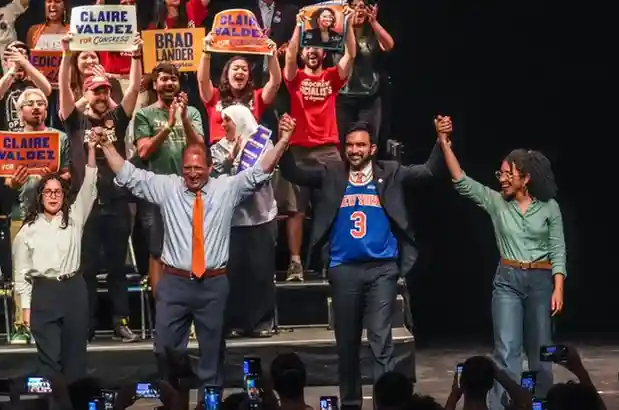
Zohran Mamdani delivered a powerful demonstration of his growing influence over New York politics as all three congressional candidates he endorsed emerged victorious in Tuesday’s Democratic primaries, reshaping the state’s political landscape and underscoring the increasing strength of progressive and democratic socialist movements within the Democratic Party. The victories marked a significant moment for the first-term New York City mayor, who actively campaigned for candidates challenging both incumbents and establishment-backed figures. The results not only highlighted Mamdani’s ability to mobilize voters but also raised important questions about the future direction of Democrats in one of the nation’s most influential political strongholds.
In one of the most closely watched races, former New York City Comptroller Brad Lander defeated incumbent Representative Dan Goldman in a Lower Manhattan-based district. Goldman, a prominent Democratic figure and former lead counsel during the first impeachment of former President Donald Trump, had the backing of key party leaders, including House Democratic leadership. Despite that support, Lander secured a decisive victory after receiving Mamdani’s endorsement and aligning himself with the progressive energy that helped propel the mayor to office.
Another major victory came in the race to succeed retiring Representative Nydia Velázquez. State Assemblymember Claire Valdez defeated Brooklyn Borough President Antonio Reynoso, who was viewed by many as the establishment favorite. Valdez’s win further cemented the influence of progressive organizations and grassroots activists who rallied behind her campaign.
In another upset, activist Darializa Avila Chevalier narrowly defeated five-term Congressman Adriano Espaillat, one of the most influential Latino lawmakers in Congress and the former chairman of the Congressional Hispanic Caucus. Avila Chevalier’s victory represented one of the night’s biggest surprises and reflected the willingness of voters to embrace new voices over longtime incumbents. All three winning candidates are expected to be strong favorites in November’s general election due to the Democratic dominance of their districts.
Their victories are likely to increase the presence of progressive lawmakers in Congress and strengthen the influence of organizations such as the Democratic Socialists of America. The results also create a new challenge for House Democratic leadership, particularly House Democratic Leader Hakeem Jeffries, who may soon have to manage a caucus with a larger and more assertive progressive wing. Political observers viewed the outcomes as evidence that many Democratic voters are increasingly frustrated with centrist approaches to issues such as immigration, economic inequality, housing affordability and U.S.
policy toward Israel. Mamdani’s endorsed candidates largely ran on platforms emphasizing economic justice, tenant protections, expanded social programs and stronger criticism of traditional political structures. Their success suggests that these messages continue to resonate strongly with a significant segment of New York’s Democratic electorate.
The victories also represent a remarkable political achievement for Mamdani himself. Since taking office as mayor, he has become one of the most recognizable progressive figures in American politics. His endorsement was considered a major factor in each of the three congressional contests, and Tuesday’s results demonstrated his ability to translate personal popularity into electoral success for allied candidates.
The mayor celebrated the victories as evidence that voters want representatives who prioritize working-class concerns and challenge entrenched political interests. Critics, however, warned that the growing influence of democratic socialist candidates could complicate efforts by national Democrats to appeal to moderate and independent voters in competitive districts. Republican strategists were quick to seize on the results, arguing that the victories would provide fresh ammunition for attacks portraying Democrats as increasingly aligned with socialist policies.
House Republican campaign officials described the results as a sign that the Democratic establishment was losing control of the party’s ideological direction. Beyond New York City, Tuesday’s primaries delivered several other noteworthy developments. In New York’s competitive 17th Congressional District, Democrats selected Cait Conley, a combat veteran and national security expert, to challenge Republican Representative Mike Lawler.
Lawler is widely viewed as one of the most vulnerable Republican incumbents in the country because he represents a district that has shown support for Democratic candidates in statewide and presidential elections. Conley’s nomination sets up one of the most closely watched House races of the 2026 midterm cycle. However, she enters the general election facing a significant fundraising disadvantage, as Lawler has already accumulated millions of dollars in campaign resources.
Another race attracting national attention unfolded in New York’s 12th Congressional District, where Micah Lasher secured victory in a crowded and expensive Democratic primary. The contest became a proxy battle involving competing factions within the technology industry and debate over artificial intelligence regulation. Outside groups spent millions of dollars supporting different candidates, making the race one of the most expensive House primaries of the year.
Lasher’s victory highlighted the growing role that technology policy and AI regulation are likely to play in future elections. Elsewhere, South Carolina Republicans held a gubernatorial runoff that produced an important result for former President Donald Trump. Attorney General Alan Wilson defeated Lieutenant Governor Pamela Evette to secure the Republican nomination for governor.
Trump had endorsed both candidates ahead of the runoff, a strategy that allowed him to avoid backing a losing contender after some of his preferred candidates had suffered setbacks in other races earlier in the month. Wilson now enters the general election as the favorite in a state that has consistently voted Republican in recent statewide elections. Maryland and Utah also held primary elections that provided insights into broader political trends.
In Maryland, Republicans nominated Dan Cox, a candidate associated with the party’s conservative wing, while Democratic Governor Wes Moore advanced in his bid for a second term. In Utah, former Congressman Ben McAdams successfully navigated a Democratic primary after repositioning himself politically to appeal to voters in a district that has become more favorable to Democrats. These contests reflected ongoing debates within both major parties about ideology, electability and the best strategies for winning competitive elections.
Yet the biggest story of the night remained Mamdani’s influence over New York politics. Analysts noted that his success extended beyond simple endorsements. His campaign infrastructure, volunteer network and political organization played an active role in supporting the candidates he backed.
Many of the volunteers who helped elect Mamdani as mayor also participated in congressional campaigns, creating a coordinated progressive effort that proved highly effective. The results are likely to encourage progressive activists nationwide, who see New York as a testing ground for policies and political strategies that could eventually spread to other parts of the country. The victories may also inspire more primary challenges against incumbent Democrats viewed as insufficiently aligned with progressive priorities.
For Democratic leaders, the challenge moving forward will be balancing the energy and enthusiasm generated by progressive activists with the need to maintain broad electoral appeal in swing districts. While progressive candidates continue to perform well in heavily Democratic areas, party strategists remain divided over whether similar approaches can succeed in more politically competitive regions. Nevertheless, Tuesday’s outcomes demonstrated that progressive candidates can win major contests when they successfully connect with voters’ concerns about affordability, housing costs and economic opportunity.
As the 2026 midterm elections approach, the impact of Mamdani’s political network will likely remain a major focus of national attention. The mayor has already established himself as one of the most influential figures in New York politics, and his ability to shape congressional races suggests that his influence may extend well beyond city government. Whether these victories mark the beginning of a broader transformation within the Democratic Party or simply reflect New York’s unique political environment remains to be seen.
What is clear is that Tuesday’s primaries delivered a significant victory for the progressive movement and reinforced Zohran Mamdani’s status as one of the most powerful political figures in the country today..
Nystate News FavoritesNystate News Favorites
- Union Leaders' Departure from DNC Reveals Deepening Rifts Within Democratic PartyUnion Leaders' Departure from DNC Reveals Deepening Rifts Within Democratic Party
- Palestinian Activist Mahmoud Khalil Rallies with Supporters in NYC Following ReleasePalestinian Activist Mahmoud Khalil Rallies with Supporters in NYC Following Release
Read More